

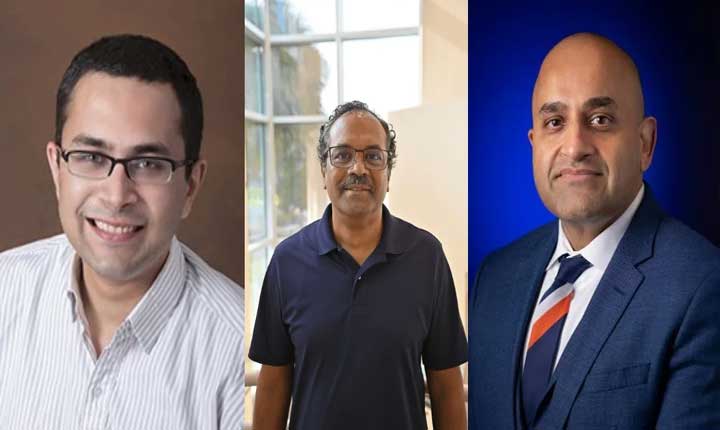


Three Indian American researchers are among 18 scientists selected by NASA for the 2026 Innovative Advanced Concepts (NIAC) Phase I awards. Designed to fund early-stage concepts with the potential to revolutionize future space exploration, this year’s program distributes a total of $3.2 million, with each project receiving up to $175,000 for a nine-month feasibility study. The selected Indian American researchers include Saptarshi Bandyopadhyay (NASA’s Jet Propulsion Laboratory), Anish Damodaran (University of Central Florida), and A.C. Charania (Zeno Power Systems).
Selected Projects and Innovations:
Saptarshi Bandyopadhyay (DimSun): Leads a study investigating whether a controllable cloud of spaceborne dust can effectively reduce the volume of sunlight reaching Earth as a potential solar radiation management approach.
Anish Damodaran (PS21): Focuses on leveraging advanced photonic technologies to optimize submillimeter space interferometry, significantly enhancing the precision and capabilities of future deep-space observatories.
A.C. Charania (Extended Astronaut Radioisotope-EVA): Aims to engineer innovative spacesuit heating mechanisms utilizing radioisotope heat sources, enabling astronauts to survive the grueling two-week lunar nights and extreme cold during deep-space missions.
Broader Program Scope and Objectives:
While these concepts do not represent official NASA missions, the broader 2026 portfolio supports diverse cutting-edge technologies, including exploration tools for lunar lava tubes, long-duration instruments for Venus, spacecraft power systems for interstellar travel, and advanced detectors for gravitational waves and black holes. Phillip Williams, acting program executive for NIAC, emphasized that the initiative provides critical early funding to nurture foundational ideas that could ultimately shape the future of aerospace innovation and space missions.