


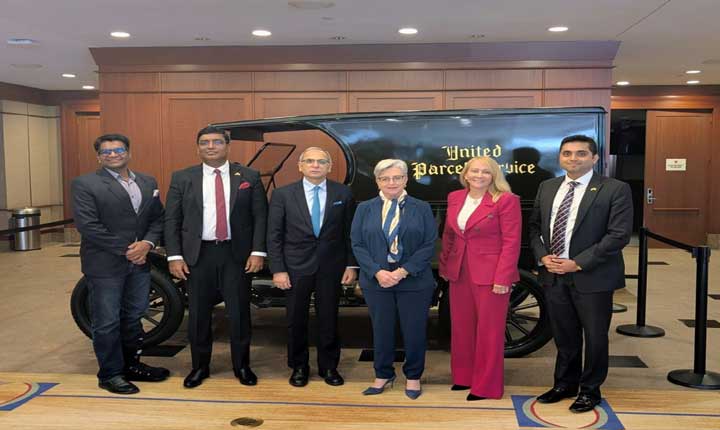


Describing the Indian diaspora as the enduring bridge connecting India and the United States, India’s Ambassador to the U.S., Vinay Mohan Kwatra, presented his vision of “one rise, two flourishes, and one thread” during an August 2 community reception at the Aashiyana Banquet Hall in Atlanta. Speaking to roughly 200 members of the Indian-American community, the Ambassador commended early immigrant pioneers, underscored India’s decade-long evolution, and recognized the diaspora’s role in cultivating one of the globe’s vital strategic partnerships. The gathering launched Kwatra’s August 2–4 Atlanta itinerary, which included meetings with Georgia Governor Brian Kemp, an academic roundtable with regional university leadership, and engagements with corporate executives to drive the India–U.S. Comprehensive Global Strategic Partnership forward.
Honoring Early Immigrants and Community Foundations:
Opening his remarks by honoring the community elders, Kwatra acknowledged their foundational role in establishing the Indian diaspora across the United States. Reflecting on his personal ties to the city dating back to his first visit in 2010 when his son enrolled at Georgia Tech he expressed appreciation for Subash and Raj Razdan, who welcomed his family and eased the transition of sending a student abroad. Kwatra defined the growth of the Indian-American population as the “first rise,” honoring those who arrived in the 1960s and 1970s, cultivated successful careers, and maintained cultural traditions while integrating into American society. Noting that the broader metro Atlanta area now hosts approximately 130,000 to 140,000 individuals of Indian heritage who excel across business, medicine, engineering, law, public service, and philanthropy, he emphasized the ongoing duty to transmit these cultural strengths and civilizational values to younger generations.
India’s Transformation and Bilateral Economic Expansion:
Shifting to the “two flourishes,” Kwatra detailed India’s domestic transformation and the subsequent strengthening of bilateral ties. Highlighting transparent governance as a foundational shift since 2014, he pointed to digital public infrastructure specifically digital initiatives like UPI and Aadhaar as key drivers of efficiency and accountability. He further emphasized financial inclusion via the Jan Dhan-Mobile framework, expanded credit access, manufacturing progress, and the national roadmap toward a developed economy by 2047. This domestic growth has directly propelled bilateral relations, with trade expanding from roughly $70–80 billion during his prior diplomatic tenure in Washington to approximately $240 billion today, alongside a shared target of reaching $500 billion by decade’s end.
The “One Thread” of the Diaspora and Institutional Engagements:
Concluding his address with the “one thread” uniting these dynamics, Kwatra characterized the diaspora itself as the permanent anchor of the relationship, dubbing the 130,000 to 140,000 community members in Georgia “real ambassadors” for bilateral goodwill. The evening also featured a special tribute to Padma Bhushan awardee and renowned marketing scholar Dr. Jagdish Sheth, recognizing over six decades of academic contributions and people-to-people diplomacy.
Continuing his official engagements on August 3, the Consulate General of India in Atlanta hosted an Education Roundtable with leaders from nearly 20 southeastern universities, including Georgia Tech, Emory University, Vanderbilt University, and the University of Florida. Kwatra encouraged collaborative research, student and faculty exchanges, and partnerships under India’s National Education Policy (NEP) 2020. Additionally, his discussions with Governor Brian Kemp focused on state economic growth, while a business reception hosted by the U.S.-India Strategic Partnership Forum (USISPF) brought together over 35 senior executives from southeastern Fortune 500 firms including Home Depot, UPS, Delta Air Lines, and Coca-Cola to explore collaborative manufacturing, innovation, and trade opportunities.