

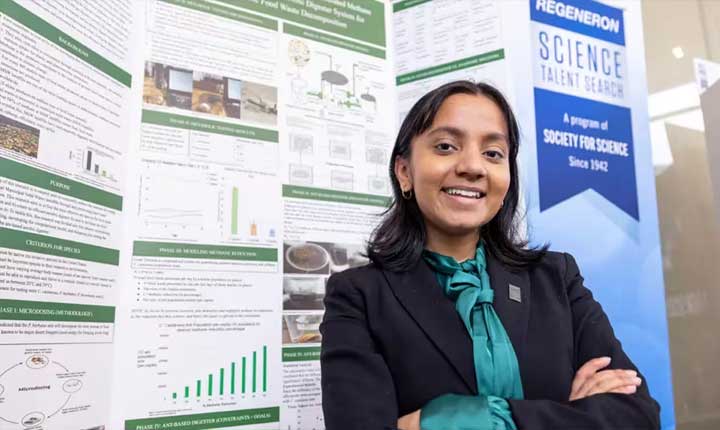


Food waste is typically viewed as a challenge that concludes in a garbage bin, yet organic material decomposing in landfills generates substantial amounts of methane a powerful greenhouse gas accounting for roughly 58% of landfill methane emissions. Addressing this environmental hurdle, Ananya Gulur Nagendra, an 18-year-old high school student from Plano, Texas, developed an unconventional biological solution for her Regeneron Science Talent Search project: an ant-based aerobic digester designed to break down food waste efficiently.
Comparative Testing of Ant Species:
To determine the most effective biological agent, Nagendra evaluated four different ant species to measure their daily waste consumption and metabolic rates. Her experiments revealed that Camponotus castaneus outperformed the other species, exhibiting the highest metabolic rate and consuming the greatest amount of food waste. This empirical foundation ensured that her waste-processing concept was backed by measurable performance data rather than mere assumption.
Prototype Development and Efficiency Results:
Following her species trials, Nagendra formulated mathematical models to estimate potential methane reductions and designed a working prototype of an aerobic digester a system where decomposition occurs in the presence of oxygen. Engineered with economic feasibility in mind, she estimated that a scaled-up version of the system could cost under $50,000. When tested, the prototype achieved an impressive 83% efficiency in processing waste. While recognized as an early-stage academic prototype rather than an immediate commercial replacement for existing infrastructure, the results provide a strong foundation for future sustainable waste-management research.
Recognition at the 2026 Regeneron Science Talent Search:
Nagendra’s creative and original research earned her a finalist spot in the prestigious 2026 Regeneron Science Talent Search, selected from a pool of 2,612 entrants and 300 scholars across the United States. By harnessing the natural scavenging behaviors of insects and integrating them into a controlled technological framework, her work highlights how nature-inspired solutions can spark fresh approaches to pressing global environmental challenges.