


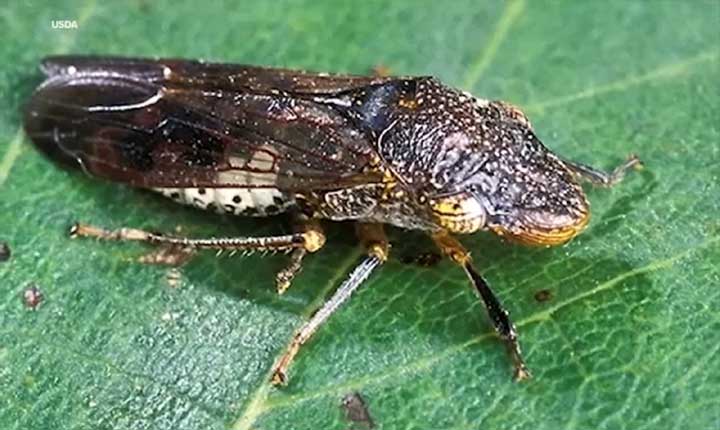


California’s winegrape industry has pledged $820,000 to combat the spread of the glassy-winged sharpshooter, a destructive insect that has currently infested 40 counties across the state. However, agricultural experts note that this amount covers only a small fraction of the total funding required to fully address the threat.
The Threat of the Glassy-Winged Sharpshooter and Pierce’s Disease:
Resembling a cricket, the glassy-winged sharpshooter transmits a fatal bacterial infection known as Pierce’s disease. This incurable ailment blocks a plant’s water-conducting systems, causing it to dry out and die. In May, the California Department of Food and Agriculture discovered that thousands of grapevines infested with the pest had been distributed to multiple Costco locations statewide, including the Tri-Valley, originating from Burchell Nursery in Fresno County.
Agricultural officials have since responded aggressively by contacting over 3,000 customers who purchased the affected plants, inspecting or destroying more than 2,900 vines, and setting upwards of 2,700 insect traps.
Funding and Economic Impact on Winegrowers:
To support a three-year tracking and eradication effort, the Pierce’s Disease and Glassy-Winged Sharpshooter Board comprising state winegrape growers acting in an advisory role committed $820,000 in emergency reserves. While the money comes from self-imposed assessments paid directly by winegrape growers rather than the state, board chair Trey Irwin emphasized the heavy economic strain the industry is currently under.
Studies show that the pest already costs growers approximately $48 million annually in lost production and vine replacement, a figure that could jump by an additional $56 million a year if the infestation spreads unchecked.
Bridging the Funding Gap:
Despite the industry’s commitment, Michael Miller, director of government relations for the California Association of Winegrape Growers, stated that $820,000 is merely a “drop in the bucket” compared to what is truly needed.
Industry estimates indicate that a minimum of $30 million to $35 million is required for just one year to cover labor-intensive tasks like home visits, tracing shipments, and managing traps.
In June, a coalition of lawmakers requested $32.2 million in emergency federal funding from the U.S. Department of Agriculture, which remains an active request.
In the meantime, the industry is lobbying the state legislature for support before its session adjourns.
Fortunately, the pest has only been detected in private residences and has not yet breached commercial vineyards. Nonetheless, agricultural leaders stress that swift, urgent action is vital to prevent the crisis from escalating further.