


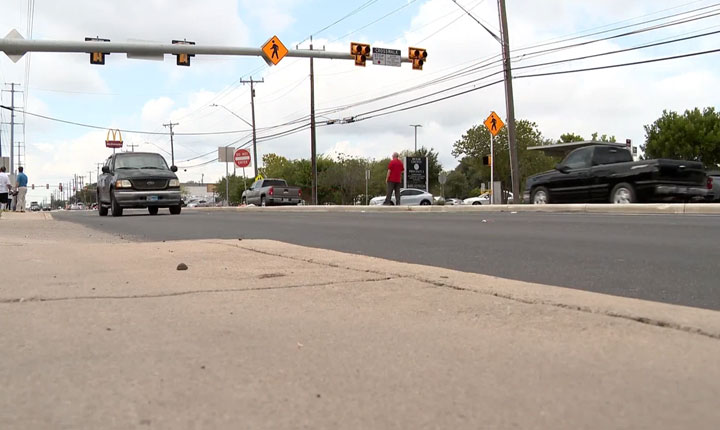


Three new pedestrian hybrid beacons are now active along Pleasanton Road on San Antonio’s South Side, providing residents with a safe way to stop traffic and cross a corridor that previously recorded five pedestrian deaths over five years and nearly 200 serious crashes annually. One of the signals is located outside the Lila Cockrell Apartments at 3500 Pleasanton Road a 70-unit complex where senior and mobility-impaired residents previously lacked a safe midblock crossing to access nearby retail centers and bus stops. Another beacon serves residents near West Amber Street, addressing an area where pedestrians previously had few safe options.
Project Funding and Scope:
According to WOAI, the beacons are part of a $3 million project financed by a TxDOT Highway Safety Improvement Program grant. The funding covered raised medians, signal retiming, a new traffic signal at the H-E-B intersection, and a full signal at Rayburn Drive along a 3.4-mile stretch of Pleasanton Road and Moursund Boulevard between Fitch Street and Loop 410, as reported by the City of San Antonio.
Local resident Luis Rodriguez noted that close calls with vehicles have been frequent, while other residents described previously having to dash across remaining lanes after running to the median. City council member Phyllis Viagran stated that these improvements are designed to reduce crashes and improve safety for all road users.
Early Safety Impacts and Operations:
Crashes along the corridor have dropped by about 13% over the past eight months. City officials intend to further promote the Keep Crossings SAfe campaign to raise awareness, though some residents noted that additional safety measures are still required further down Pleasanton Road, particularly for children who do not use designated crosswalks.
Pedestrian hybrid beacons remain dark until a button is pressed, activating a red stop-signal sequence that halts traffic to allow safe crossings. Federal Highway Administration research indicates these devices decrease pedestrian crashes by 55% to 69% and overall roadway crashes by 29%, achieving 97% driver compliance once activated.
Community Pushback and Median Redesigns:
The Pleasanton Road overhaul encountered significant opposition. In May 2025, over 2,600 residents and business owners signed petitions against the project’s raised concrete medians, citing concerns from small business owners like Tomas Uresti and Juan Mancha that tight turnarounds caused vehicle damage, blocked emergency U-turns, and reduced customer foot traffic.
In response, District 3 officials and San Antonio Public Works collaborated with TxDOT to shorten medians, taper curbs, and widen turnarounds near Harlandale High School and commercial areas. The Harlandale-McCollum Neighborhood Association also worked directly with city engineers regarding sightline concerns during the redesign.
Broader Safety Context and Citywide Initiatives:
Pleasanton Road’s high-speed, five-lane design and mix of destinations such as schools, an H-E-B, and senior housing—qualify it as a High-Injury Network corridor. In 2024, San Antonio recorded 769 pedestrian-involved traffic incidents, causing 83 deaths and 168 serious injuries, placing the city among the top seven deadliest per capita in the country for pedestrians. Bexar County accounts for 93% of the more than 1,000 annual pedestrian-involved collisions across the eight-county San Antonio metro area, according to TxDOT Crash Records Information System data, with roughly 60% of all citywide pedestrian crashes occurring on state-managed TxDOT corridors.
To combat these figures, the city launched its $4.4 million Keep Crossings SAfe education campaign and an interactive High-Injury Network Dashboard in late 2025 as part of its Vision Zero initiative. Additionally, San Antonio secured a $4.4 million federal Safe Streets for All grant to construct eight midblock crosswalks along a 7.5-mile stretch of Zarzamora Street, another High-Injury Network corridor.