

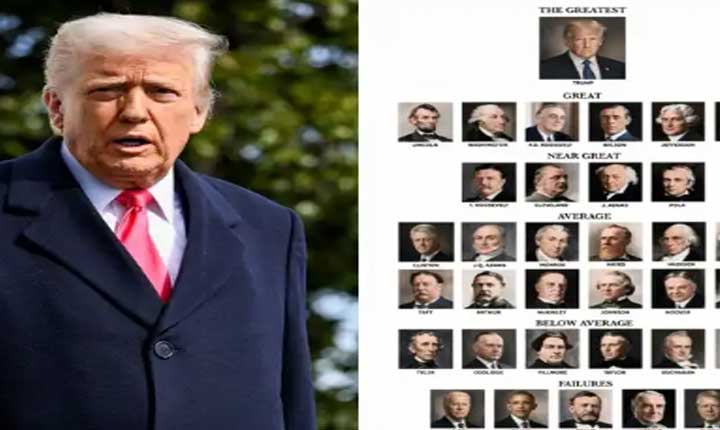


President Donald Trump stirred considerable debate by publishing a personalized evaluation of former U.S. leaders on his Truth Social platform, reserving the absolute apex of the chart exclusively for himself under the label “The Greatest”
Tiered Classification and Modern Rivals:
The shared graphic sorted 34 historical chief executives into six distinct brackets: “The Greatest,” “Great,” “Near Great,” “Average,” “Below Average,” and “Failures”. While legendary figures like George Washington and Abraham Lincoln landed in the secondary “Great” tier, modern Democratic leaders including Barack Obama, Joe Biden, and Jimmy Carter were relegated to the bottom “Failures” category. Meanwhile, Bill Clinton secured an “Average” designation.
Polling Context and Historical Omissions:
The social media post functioned as a direct reaction to a CNN broadcast highlighting a survey where 53 percent of registered Republicans named Trump as their most admired U.S. president, eclipsing historical icons such as Ronald Reagan and Abraham Lincoln.
Despite his strong standing among GOP base voters, political commentators noted glaring absences in Trump’s lineup, with several prominent Republican predecessors such as Ronald Reagan, Richard Nixon, and both George H.W. and George W. Bush left off the roster entirely. Media analysts pointed out that the graphic closely mirrors a historical presidential evaluation originally published by LIFE magazine in 1948, retaining its foundational structure and vintage portraits while injecting recent commanders-in-chief and a custom top tier. The ranking arrives as broader public sentiment faces headwinds, with recent Reuters/Ipsos polling placing his nationwide approval rating at 33 percent amid ongoing overseas conflicts and domestic economic friction, contrasting sharply with a 2024 academic survey of scholars that placed him at the bottom of historical presidential evaluations.