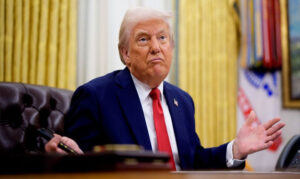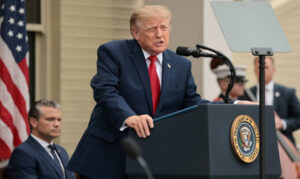


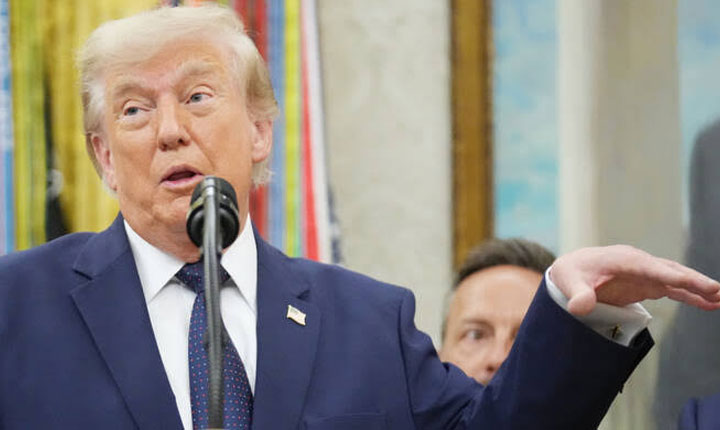


U.S. President Donald Trump warned that the United States would hit Iran “hard” following a sudden exchange of fire that shattered weeks of relative calm. The military escalation comes amidst a six-month-long conflict characterized by a strategic impasse, with Iran maintaining the closure of the vital Strait of Hormuz while the U.S. enforces a counter-blockade against Iranian ports.
The latest hostilities erupted after the U.S. military launched strikes on Sunday, August 30, targeting Iranian rocket launchers on Larak Island in the Strait of Hormuz. Washington stated the operation was necessary to prevent Tehran from laying mines in the critical commercial shipping lane. Iranian state media reported that three people were killed and several others wounded in the Larak Island strike.
In retaliation, Iran launched missile and drone attacks directed at U.S. military positions in the region. The Islamic Revolutionary Guard Corps (IRGC) claimed that ballistic missile strikes on two U.S. air bases in Jordan caused heavy damage, and asserted that a second U.S. drone was shot down over the strait on Monday evening. However, President Trump disputed these claims, telling Fox News that nearly all incoming missiles were successfully intercepted, with only one getting through that posed no threat. Jordan’s military confirmed intercepting eight missiles, while the UAE reported intercepting a drone over its territorial waters and dismissed Iranian claims targeting the Al Minhad Air Base as baseless.
The renewed clashes have further heightened concerns over the security of the Strait of Hormuz, a crucial corridor through which roughly one-fifth of the world’s oil supply historically flows. Although the shipping lane remains closed to commercial traffic and continues to rattle global energy markets, President Trump claimed the U.S. Navy maintains “total control” of the waterway following explosives-clearing operations. Conversely, the IRGC insisted it retains control, reporting that an oil tanker caught fire after striking two mines on an unauthorized route—a claim the U.S. military flatly rejected as disinformation.
Alongside direct military actions, the Trump administration is aggressively intensifying economic pressure on Tehran. President Trump took to social media to label Iran a “failed nation” with a decimated military, crumbling finances, and leadership in disarray. U.S. Treasury Secretary Scott Bessent, speaking at a G20 meeting in North Carolina, vowed to maintain economic warfare, suggesting a decisive turning point in the pressure campaign could materialize within weeks or months.
Despite the military and economic squeeze, Iranian leadership has expressed openness to de-escalation through diplomatic channels. Speaking at a summit in Kyrgyzstan, Iranian President Masoud Pezeshkian called for dialogue and cooperation, stating that continuing the war serves neither Iranian nor regional interests. Similarly, Iranian Foreign Minister Abbas Araghchi urged Washington to return to previous commitments to pave the way back to negotiations, even as international mediators continue struggling to secure a lasting truce.