

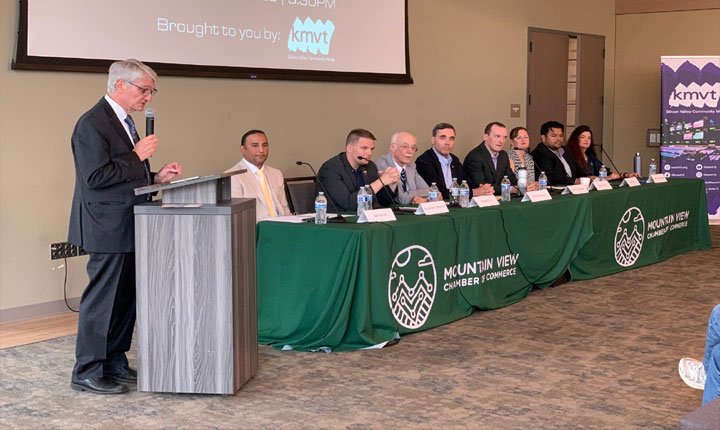


Ahead of the November 3 election, the Mountain View Chamber of Commerce hosted a candidate forum on August 27 at the Mountain View Community Center, featuring eight contenders vying for three seats on the City Council. Moderated by chamber president and CEO Peter Katz, the event drew more than 50 attendees and covered key community priorities, including small business support, housing, and economic vitality.
While the candidates reached a consensus on several topics agreeing unanimously that the city’s permitting process should be more streamlined and expressing strong backing for a ballot measure designed to increase the hotel tax they diverged sharply on downtown housing and commercial development.
Small Businesses and Economic Growth:
Candidates emphasized the need to foster local economic vitality by reducing bureaucratic hurdles for merchants. Entrepreneur and local activist IdaRose Sylvester stressed the importance of getting out of businesses’ way to facilitate faster success, while community advocate Erik Poicon recommended strengthening pre-lease assistance and closely monitoring closure rates. High school teacher Silja Paymer advocated for expanded mixed-use zoning, joining Poicon in supporting a storefront vacancy tax for long-term empty properties. Google security specialist Samuel Ali highlighted the value of city partnerships and social media promotion, and U.S. Army officer Alexander Amoroso identified employee retention and workforce housing as critical solutions to high turnover.
Housing Development and Senate Bill 79:
Discussions on housing centered around the implementation of Senate Bill 79, a state law promoting high-density housing near major transit nodes such as Caltrain and VTA light rail stations. Software engineer and Mountain View YIMBY member James Kuszmaul strongly endorsed SB 79, asserting that residents need increased access to transit-adjacent housing and emphasizing the necessity of clear objective design standards.
Conversely, candidates associated with historic preservation concerns expressed reservations. Retired Intel engineer Robert Cox (Livable Mountain View) and microprocessor engineer Paul Donahue criticized SB 79 as a rigid “one size fits all” mandate that threatens historic properties along Castro Street. Both favored establishing a localized alternative plan to shift residential density to other neighborhoods, a sentiment echoed by Sylvester and Paymer. Kuszmaul opposed an alternative plan, arguing it would misallocate municipal resources without delivering superior results.
Office Development Preferences:
Opinions on expanding office space varied between downtown and the North Bayshore region. For downtown office development, Ali, Amoroso, and Poicon expressed support, Kuszmaul answered “a bit,” Sylvester said “yes” conditional on project type, and Cox, Donahue, and Paymer rejected the idea. Regarding large-scale office growth in North Bayshore a 30-year projected zone tied to Google-led initiativesAli, Cox, and Poicon answered affirmatively, while Paymer conditioned her support on developer contributions. Kuszmaul answered “a bit,” Sylvester supported complete communities, Amoroso voted “no,” and Donahue replied “maybe.”