


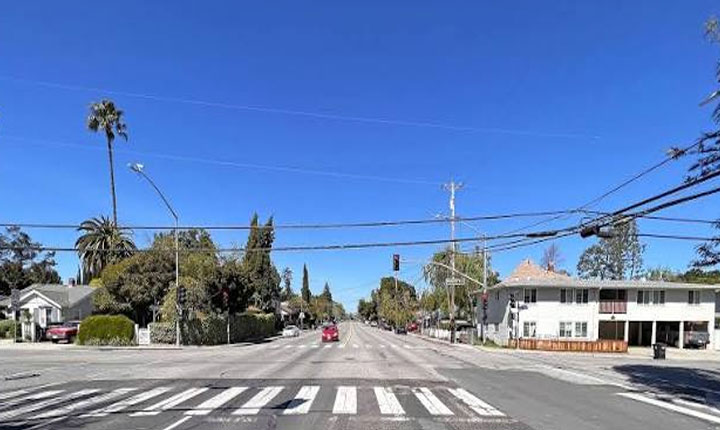


Mountain View’s Council Transportation Committee is guiding the redesign of the 1.7-mile Rengstorff Avenue corridor which spans from El Camino Real to Leghorn Street and features heavily in the city’s High Injury Network due to a history of severe collisions while intending to keep all four current vehicle lanes intact. At a recent committee meeting, approximately two dozen community members attended to advocate for enhanced sidewalks, crosswalks, and protected bike lanes along the busy street. The corridor currently accommodates two vehicle lanes in each direction, on-street bike lanes, and roughly 250 parking spots concentrated largely north of Central Expressway, alongside serving as a vital Safe Routes to School path and a transit route for VTA bus lines.
City staff detailed three distinct design options for the committee, each balancing parking and bike infrastructure tradeoffs differently:
Alternative A: Operates as a baseline option that preserves all existing on-street parking while enhancing intersections and safety at critical crossings near Wyandotte Street, Junction Avenue, and the Waldorf school.
Alternative B: Builds on the baseline by introducing protected bike lanes, though it necessitates cutting about 64% of the corridor’s street parking.
Alternative C: Integrates wider sidewalks and green elements onto Alternative A, requiring the elimination of roughly 48% of parking.
Transportation Manager Lauren Ledbetter noted that combining every feature of all three alternatives is unfeasible without accepting tradeoffs, mentioning that reducing vehicle lanes was among the options initially evaluated.
Committee Divisions and Traffic Impact Findings:
City council members remain divided on how to prioritize parking removal against pedestrian and bicyclist safety enhancements. John McAlister opposed adding protected bike lanes and argued that eliminating street parking would harm the broader community while disrupting vehicle accessibility vital for public transit. Conversely, Ellen Kamei advocated for a combination of Alternatives B and C to support community requests for a more walkable and bikeable city, especially for student safety. Alison Hicks recommended narrowing medians to carve out space for protected bike lanes and targeted parking cuts, viewing sidewalk widening as a lesser priority.
Although some community members pushed to reduce driving lanes entirely, a citywide traffic analysis revealed that cutting travel lanes would trigger significant and unacceptable intersection impacts. Consequently, the committee directed staff to further clarify the tradeoffs before proceeding.
State Backing, Prior Upgrades, and Broader Comparisons:
The corridor redesign is supported by a $352,000 Caltrans grant awarded for the Rengstorff Avenue Complete Streets Study, following its ranking as the highest-priority corridor in the city’s Comprehensive Modal Plan. Targeted safety work has already begun, including a $1.16 million traffic signal and safety overhaul completed in December at Latham Street, which added protected left-turn phases, green bike lane markings, and real-time AI video detection.
Unlike Rengstorff, Mountain View has executed road diets elsewhere such as reducing El Monte Avenue from four lanes to three in 2023 and beginning a four-to-three lane pilot on California Street in 2025 demonstrating past willingness to trade vehicle capacity for safety. However, Rengstorff features unique complexities, including:
Caltrain’s Rengstorff Avenue Grade Separation Project, featuring a new pedestrian overcrossing.
Planned interchange upgrades by the Santa Clara Valley Transportation Authority and Caltrans near U.S. 101.
Utilization by the Mountain View Police Department as an event traffic detour during Fourth of July celebrations at Shoreline Amphitheatre.
Furthermore, broader multimodal progress continues to face headwinds, such as staff shortages in the transportation division which recently operated with only two of five positions filled, leading to the shelving of a bike lane study on Terra Bella Avenue. Public engagement on the Rengstorff project includes a community survey open through September 11, with staff intending to select a single preferred design by early 2027 for a full City Council review in April 2027.