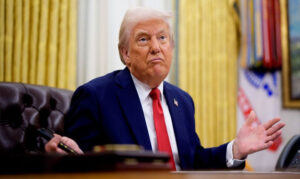


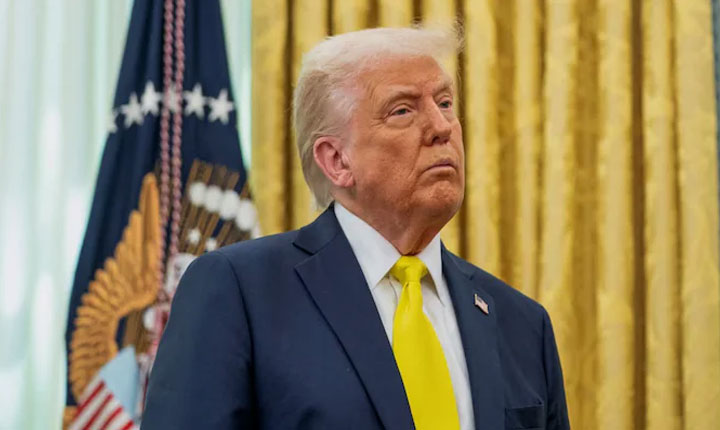


US President Donald Trump has explicitly ruled out the use of nuclear weapons against Iran, asserting during an Oval Office event that there is no justification for deploying them after Tehran has already been heavily weakened militarily. Dismissing the inquiry as unnecessary, Trump stated, “I rule out….there’s no reason for it,” and questioned why Washington would resort to a nuclear strike given the current military situation.
The remarks follow a fresh wave of military escalations that disrupted weeks of relative calm between the two nations. The hostilities reignited after a US strike targeted Iranian rocket launchers on Larak island in the Strait of Hormuz on Sunday to prevent Tehran from laying mines. Iranian state media reported that three people were killed and several others wounded in the attack, prompting the Islamic Revolutionary Guard Corps (IRGC) to launch missiles and drones toward US military positions, claiming heavy damage on two bases in Jordan. Conversely, Trump maintained that nearly all incoming missiles were intercepted without posing a significant threat, a statement supported by Jordan’s military report of intercepting eight missiles and the UAE’s confirmation of intercepting a drone over its waters.
The confrontations have placed the critical Strait of Hormuz at the center of the geopolitical crisis. The vital shipping lane through which roughly one-fifth of the global oil supply historically passes remains closed to commercial traffic alongside a US counter-blockade of Iranian ports, sending shockwaves through international energy markets and driving up oil prices. While Trump asserted that the US Navy maintains “total control” of the waterway and has cleared explosives, the IRGC disputed this, claiming a tanker caught fire after striking two mines on an unauthorized route, a report the US military flatly rejected as disinformation.
Alongside conventional military maneuvers, the Trump administration continues to ramp up economic pressure. Describing Iran as a “failed nation” with deteriorating finances and leadership in “total disarray,” Trump signaled a hardline stance, while US Treasury Secretary Scott Bessent confirmed at a G20 meeting in North Carolina that Washington will continue tightening economic restrictions, expecting potential turning points within weeks or months.
Despite the intensifying military and economic squeeze, Iranian leadership has reiterated calls for diplomacy. At a summit in Kyrgyzstan, Iranian President Masoud Pezeshkian emphasized that Tehran is still pursuing a peaceful path, asserting that ongoing conflict benefits no one and that crisis resolution depends on “dialogue and cooperation.” Foreign Minister Abbas Araghchi similarly urged Washington to return to past commitments to steer negotiations back on track.