

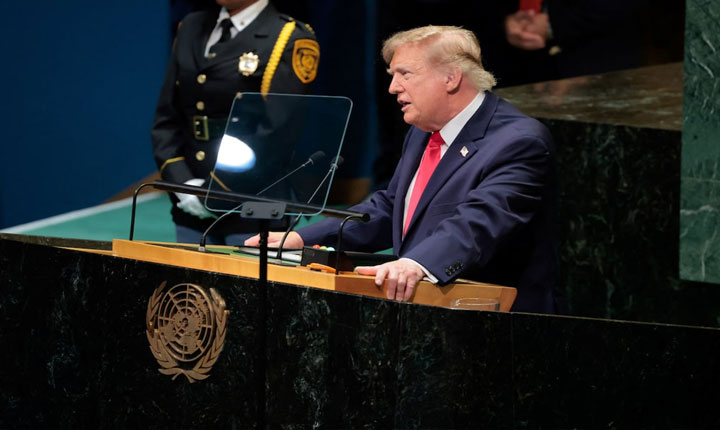


During his address at the UN General Assembly in New York, US President Donald Trump announced that his administration is replacing the term “artificial intelligence” with “Superintelligence” (SI), arguing that the word “artificial” incorrectly implies the technology is fake. Trump stated that this new nomenclature will be integrated into all US government documents, expressing hope that other global nations will follow suit. While highlighting that the technology is real, transformative, and potentially larger than the Industrial Revolution or the internet, he acknowledged it brings challenges requiring careful oversight.
Rejection of Global Regulation and Existential Warnings:
Trump firmly rejected proposals for an international system to govern the technology, characterizing such initiatives as a “globalist scheme” aimed at controlling its development. Dismissing warnings regarding existential threats posed by advanced technologies, he likened those concerns to recurring predictions surrounding climate change. Furthermore, he asserted that the United States will not restrict technological growth, though law enforcement agencies will monitor the sector and intervene when necessary.
Strategic Competition and Global Leadership:
Framing the advancement of the sector as a critical geopolitical race, Trump emphasized that global power will depend on technological supremacy. Declaring that “whoever wins Superintelligence wins,” he claimed that the United States currently holds a substantial lead over China and other global competitors, pledging to maintain that advantage. The administration did not immediately detail the specific implementation mechanisms or executive orders required to transition government terminology across agencies, nor did it clarify whether the “Superintelligence” label applies to all AI models or solely advanced systems.