

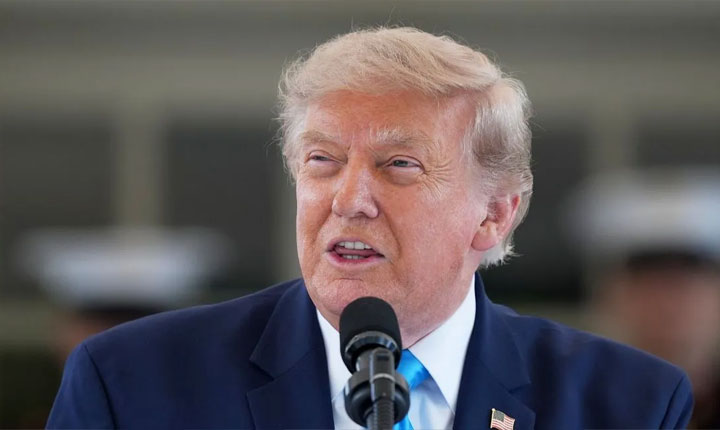


US President Donald Trump has signed a new executive order directing federal agencies to scrutinise H-1B visa applications from companies that have recently laid off American workers or are planning job cuts that could affect similar domestic employees. This development comes as the US extended the USD 1,00,000 fee for H-1B visas by another year despite facing legal challenges. Both of these policy moves stand to indirectly impact Indian technology workers, who dominate the H-1B visa program by securing roughly three out of every four approved visas, forming the backbone of America’s tech sector and Silicon Valley giants.
Since assuming office, Trump has intensified his crackdown on H-1B visas as part of a broader drive to create more jobs for American citizens. Last month, the Department of Homeland Security proposed a new rule to eliminate the 60-day grace period for H-1B and other non-immigrant visa holders after a job loss, leaving affected workers with far less time to secure another lawful avenue to remain in the US. Under the latest executive order, the State Department, Labour Department, and Homeland Security are directed to coordinate more closely while processing applications to determine whether sponsoring employers have directly or indirectly carried out layoffs or plan job cuts affecting US workers.
The White House stated that the order is aimed at curbing the misuse of the H-1B program by companies using foreign workers to replace American employees or reduce labor costs. The order notes that between 8,00,000 and 1.3 million American employees were laid off from 2022 through 2026, with some employers even forcing laid-off American workers to train their foreign replacements, while certain outsourcing companies bring H-1B workers to the US before eventually shifting their work overseas. While the order does not impose a blanket ban or dissuade companies from hiring H-1B workers, it mandates amplified scrutiny on layoffs, wage levels, employment duties, and qualifications during the processing of labour condition applications (LCAs), visa petitions, and H-1B visas. Furthermore, the Labour Department has been given 30 days to start reviewing previously filed LCAs to determine if action is needed against any companies.
The impact of this order will depend entirely on how US agencies implement the new rules and operational guidance requested from the Secretary of State, Commerce Secretary, Labour Secretary, and Homeland Security Secretary. Companies that have recently laid off American employees will likely face additional checks when sponsoring H-1B workers for similar positions, making some employers more cautious. Reacting to the order, the Foundation for India and Indian Diaspora Studies (FIIDS) stated that jobs requiring highly specialized skills cannot always be filled immediately from the domestic labor pool, noting real and highly specific skill gaps in areas like AI and cybersecurity, and emphasized that the answer is not to pit American workers against high-skilled immigrants. Additionally, US Labour Department inspector general Anthony D’Esposito warned businesses whose models depend on gaming the immigration system of upcoming investigations, tweeting that a visa is not a license to cheat American workers.