

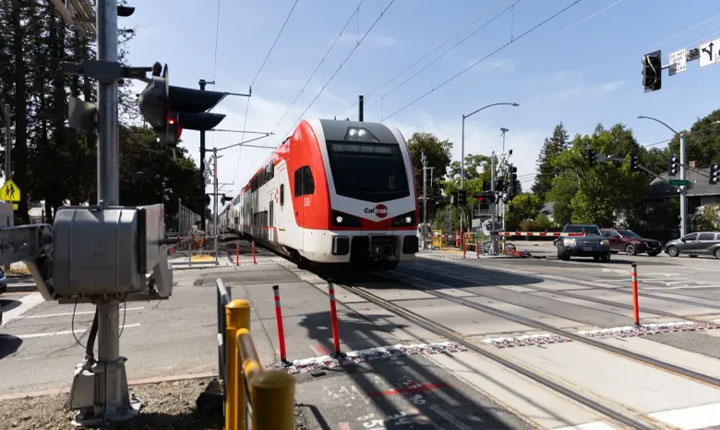


After over a decade of planning, debating, and exploring grade separation across multiple local rail crossings, Palo Alto’s elected leaders are preparing to narrow their focus to a single location: Charleston Road. Formally, the City Council remains committed to reviewing 15% designs for Charleston Road, East Meadow Drive, and Churchill Avenue later this month and advancing them to 35% design to enable environmental analysis and grant applications. However, members of the council’s Rail Committee acknowledged that the cumulative construction costs projected at more than $1.5 billion for all three sites make pursuing every project simultaneously unrealistic. According to Caltrain estimates, a partial underpass for cars at Churchill Avenue would cost between $420 million and $450 million, a car underpass at the busy Charleston crossing would range from $480 million to $530 million, and a hybrid design pairing Charleston with East Meadow Drive would push expenses between $1 billion and $1.3 billion.
Committee Concerns and Shift Toward Charleston Road:
All three committee members Chair Pat Burt, Julie Lythcott-Haims, and Ed Lauing stressed that funding remains a major hurdle. Lauing described the projected figures as staggering and suggested that the city formally pause work on the other crossings to concentrate entirely on Charleston Road to address immediate needs. Lythcott-Haims pointed out that even preferred alternatives carry flaws, such as requiring partial or full property acquisitions, and questioned the likelihood of securing the necessary state, federal, and regional backing. Burt, who also sits on the Caltrain board, emphasized that limiting ambitions to an underpass for cars at Charleston alongside a pedestrian and bicycle underpass near Matadero Creek would already constitute a massive, historically complex undertaking.
Mental Health Reports and Safety Measures:
This shift in conversation follows earlier community debates regarding the Churchill Avenue crossing, where a potential closure was previously considered following student suicides before being abandoned by the council in May. While a recent report from the Jed Foundation recommended pursuing grade separation at all railway crossings alongside measures like high-security fencing and intrusion detection systems to reduce access to the right-of-way, committee members pushed back. Burt argued that attempting to fund and build grade separations across all four existing crossings would cost roughly $2 billion and take at least two decades, making the foundation’s broad recommendation impractical for the city. Meanwhile, the city and the Palo Alto Unified School District continue to split an annual $1.7 million cost for security guards patrolling the tracks, complementing safety infrastructure already deployed by Caltrain, such as AI-driven LiDAR intrusion detection systems.