

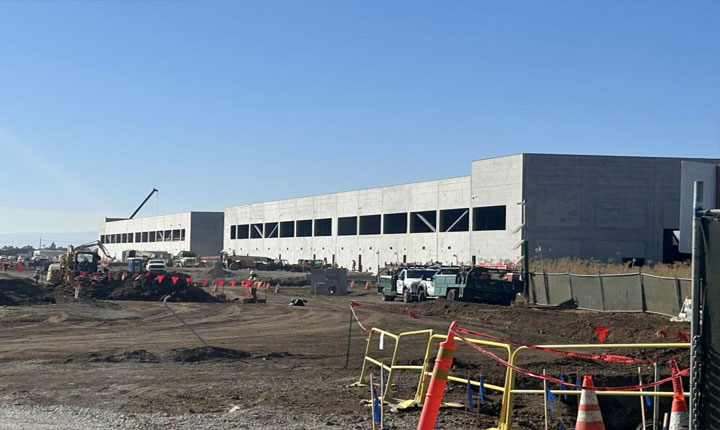


An Amazon data center currently under construction in Gilroy has sparked frustration among local residents and a transparency group over the city’s alleged lack of openness regarding the project’s approval. Americans for Transparency, a grassroots organization led by Gilroy resident Georgine Scott-Codiga, filed a formal demand of violations with the city, alleging that the land housing the data center development breached the California Subdivision Map Act. Scott-Codiga urged the city attorney and the Gilroy City Council to halt water connection applications for Amazon, formally investigate whether the parcel was illegally created, refer the matter to Santa Clara County for enforcement, and notify Amazon that no approvals will be issued until the parcel defect is corrected.
City Administrator Matt Morley countered that officials and City Attorney Andrew Faber thoroughly reviewed the claims and found no infractions, stating that the actions complied fully with the California Map Act. Morley explained that in July 2020, Arcadia Associates and Glen Loma Southpoint Group executed a lot line adjustment across five plots of land along Camino Arroyo Drive, which altered parcel sizes without creating new parcels, a process approved by the city engineer prior to Amazon Data Services purchasing the larger tract. Mayor Greg Bozzo noted that while the 2020 adjustment did not require city council or Planning Commission involvement that would have allowed public comment, the council approved changes on August 17 to mandate community meetings, mailed notices for nearby residents, and planning commission reviews for future large-scale developments.
Environmental and Resource Worries Raised by Residents:
Beyond procedural transparency, Americans for Transparency highlighted environmental worries, pointing to more than 25 diesel-powered generators planned for a higher-pollution zone alongside excessive water usage, low job creation numbers, and compromised public input. Local resident Victor Thibeault criticized the city’s focus on projected tax revenues estimated at $40 million within the first decade, including $1.6 million in 2028, $4.2 million annually by 2032, and $6 million annually by full buildout in 2037 arguing that revenues fall short of covering infrastructure expenses needed if groundwater supplies grow insufficient.
Amazon’s Response and Community Investments:
Addressing the backlash, an Amazon spokesperson, Adrienne Talbot, maintained that the project adhered to standard multiyear approval processes for an industrially zoned parcel while acknowledging that residents desired earlier engagement. Talbot highlighted that Amazon has since hosted community open houses and is committed to ongoing dialogue. The company’s $2 billion investment aims to inject an estimated $532 million into the gross domestic product, generate 90 on-site jobs alongside 160 broader community roles, fund local land conservation and water replenishment initiatives, utilize 100% carbon-free energy, transition to 100% recycled water by 2030, and cover all associated infrastructure costs locally.